
how to rainbow market if you don’t support lgbtqia+ rights, in 2 easy steps
In the spirit of public service, here is a practical guide to rainbow marketing if your company does not support LGBTQ rights. Follow these steps and you will achieve the full effect: alienating the community you're targeting and setting your brand equity on fire before July.
June arrives and something remarkable happens. Logos turn rainbow, limited-edition merchandise appears, brands that spent the previous eleven months donating to anti-LGBTQ politicians suddenly discover their deep and abiding love for the community. It is a reliable cycle, and audiences (particularly the queer audiences these brands are courting) have gotten very good at clocking it.
So in the spirit of public service, here is a practical guide to rainbow marketing if your company does not support LGBTQ rights. Follow these steps and you will achieve the full effect: alienating the community you're targeting and setting your brand equity on fire before July.
Step One: Don't Do Anything the Other Eleven Months
The most straightforward on the list. And we get it! No photo opportunities, no LGBTQ support. A Pride campaign out of nowhere is a transaction: their attention for your revenue, no values exchange required. At least you’re up front about it. Bonus points if you, like a number of Fortune 500 companies, run Pride campaigns while your political action committees fund lawmakers who sponsored or voted for anti-LGBTQ legislation. (P.S., The Human Rights Campaign Corporate Equality Index tracks this.)
Jokes aside, when a company runs a Pride campaign, it is asking queer people and their allies to trust it with their sense of being seen. That is a significant ask. This is a community that has been demonstrably harmed by institutions—including corporations—performing support and then disappearing when push comes to shove.
Subaru understood this, which is why their relationship with LGBTQ consumers is a 30-year case study rather than a cautionary tale. In the mid-1990s, Subaru's marketing team discovered that lesbians and gay men over-indexed in their customer base alongside skiers, teachers, and nurses. Rather than pivot away from that finding, they committed to it, incrementally at first, then more openly as the years went on. Their early ads featured same-sex couples before doing so was mainstream or commercially safe.
They built a relationship before they built a campaign.
Step Two: Fold the Moment Anyone Complains
Target spent years building a Pride collection. In 2023, under a wave of threats and pressure, they pulled products and moved displays to the back of stores. Bud Light partnered with trans creator Dylan Mulvaney on a small campaign that same year, and when backlash hit, company executives publicly distanced themselves from their own marketing decision, leaving Mulvaney without support while the campaign was still live.
In the mid-to-late 1990s when Subaru’s ads started running, The American Family Association called for boycotts. Subaru didn't pull campaigns or issue apologies, and their sales grew anyway.
Now, the people most likely to boycott Subaru over LGBTQ content have already self-selected out of being Subaru customers, or who understand that’s just who Subaru is—like the (promise to come back here after you click) “hungry first, gay second” Chick-fil-A meme. Chick-fil-A never lied about who they were. The brand has been building this association long enough that its customer base organically became people who were fine with it or actively drawn to it. There was no silent majority of Subaru buyers who were surprised and offended. The surprise had already happened years earlier, and those people bought Toyotas instead.
You Can, In Fact, Make Everyone Mad
We’ve been taught since grade school that you can’t please everyone. But, if you rainbow wash during Pride month, you can, in fact, please no one.
Take Target for example. Target is a mass-market retailer whose value proposition is that everyone shops there. When they introduced Pride merchandise, they were introducing it to a customer base that included a significant slice of people who had never associated Target with any particular values stance because Target had never really taken one. That offended people who thought Target shouldn’t support LGBTQ rights and also people who thought Target hadn’t earned the right to take their money for LGBTQ products.
Subaru's LGBTQ customers and allies are loyal, repeat buyers who feel personal ownership over the brand. When the AFA came for Subaru, those customers actively defended them. When Chick-fil-A went viral for not supporting LGBTQ rights, its customers lined up in record numbers.
Rainbow washing brands don't have that. They get the backlash with none of the loyal constituency to absorb it.
With that said, a company can run a meaningful Pride campaign without Subaru's 30-year track record. The companies that get destroyed are the ones whose Pride presence is out of proportion with what is true inside, whose campaigns imply a depth of commitment that evaporates when the month is over.
There Are No Shortcuts to Building Trust
This is, at its core, a messaging problem and it obeys the same rules as every other messaging problem. Authenticity is not a creative brief. Authenticity predates the creative brief, earned before the campaign. An audience with genuine stakes in whether you mean what you say will figure out whether you mean what you say.
There are no shortcuts to building trust with the LGBTQ community. There are plenty of shortcuts to destroying it. Asking for someone's loyalty and money without having earned either is one of the fastest.
— Britta
LAHO is a PR and marketing agency for professional service firms, emerging brands, and public figures. Think PR with punch, marketing with mood, and the strategy a vision board would hire. We pride ourselves on having creative ideas and being strategy-first, so all the stand-out things we do to build visibility and growth are also backed by experience & data. Need help building trust and authenticity with your audience? Reach out here.
social media content isn't marketing
I’m going to hold your hand super tight when I say this: If you’re posting on social media and telling yourself you’re marketing your product/brand… you’re not.
I see a lot of people who are extremely active on social media and they’re telling me (the viewer) that marketing is exhausting and they’re so tired of constantly promoting their product or their brand. And their content looks great, but then I’ll hop over to their profile and find myself at a dead end. No website link in bio, or there’s a link tree but it’s driving me to the third-party product page.
I’m going to hold your hand super tight when I say this: If you’re posting on social media and telling yourself you’re marketing your product/brand… you’re not.
Social media isn’t marketing. On its own. It exists as a facet of marketing, something that you leverage during a specific phase in your traffic funnel. When you’re posting your meticulously curated and on-trend content, what you’re doing is building awareness. You’re putting the product or your brand or whatever you’re wanting to convert out into the world and you’re saying “hey, look at this super cool thing!” And maybe you’ll reach a smaller percentage of your audience that sees that and wants to know more about your product, your brand, and then what?
Then what?
If you don’t have a link to your website or any place for them to do anything with their curiosity, you’ve missed a potential opportunity. They’ve scrolled on. They’re lost to the algorithm, and you can only hope that by the grace of that same algorithm you’ll be granted a second chance with them (and hopefully have a clearer funnel for them to follow).
I’m passionate about having a marketing funnel and being intentional about it. Do you have one? If you’re trying to sell something, you should. If you’re posting trendy videos and calling it marketing, you should definitely have a funnel.
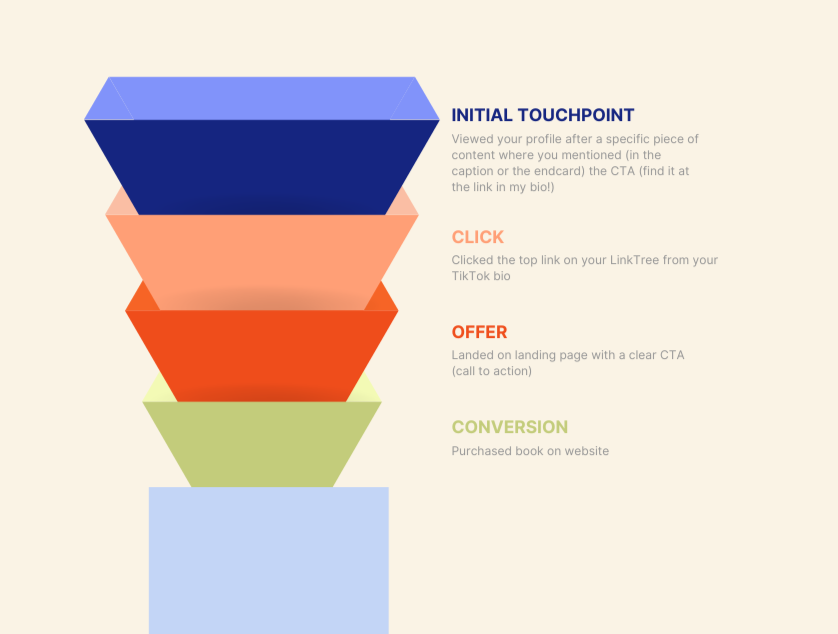
What does a funnel look like?
You need to start at your product or the action you’d like your desired audience to take and work backwards from there. Maybe it’s, purchase a book from your website because you have a higher profit margin there as opposed to Amazon.
Purchased book on website →
Landed on landing page with a clear CTA (call to action) →
Clicked the top link on your LinkTree from your TikTok bio →
Viewed your profile after a specific piece of content where you mentioned (in the caption or the endcard) the CTA (find it at the link in my bio!)
And this works for literally everything.
Don’t have a website store? Drive them to Amazon instead. Make the funnel path intentional and clear in its steps.
CTAs are your friend, people like being told what to do next, especially when the purchase intent is already there.
I can count the number of times on two hands that I’ve tried to make a purchase somewhere and the process was too hard or the steps were muddled and I just gave up. You have a narrow window of time to capture that purchase intent, so use it wisely.
Want to grow your newsletter list instead? Change the funnel steps. The conversion action is now signing up for your newsletter. Work backwards from there.
Do a pulse check on your marketing today. Do you have a funnel? How easily can you remedy that? Maybe it’s just adding a link to your bio for today. Need more help figuring out how exactly you want your funnel to work? Book a strategy session with us and we’ll happily build the plan with you.
— Natalie
LAHO is a marketing and communications agency helping founders, businesses, and creators grow relevance and revenue. Think PR with punch, marketing with mood, and the strategy a vision board would hire. We execute cohesive strategies across earned, owned, and paid media to build influence with intention through senior-led storytelling and smart distribution. Need strategy, content, PR, or ads? Reach out here.
stop sending lame PR merch. send an artifact.
It’s easy to look at those massive, multi-hundred-dollar sends from Big 5 publishing houses and just assume modern PR is just a race to see who can be the loudest brand on the timeline.
But scale is a lazy substitute for strategy.
If you spend ten minutes on BookTok, you’ll see the influencer hauls. Bookmail chock full of themed freebies like stickers, perfumes, dried flowers, and enough branded filler to sink a ship. It’s easy to look at those massive, multi-hundred-dollar sends from Big 5 publishing houses and just assume modern PR is just a race to see who can be the loudest brand on the timeline.
But scale is a lazy substitute for strategy.
When we took on influencer management and PR for a debut indie author client recently, we knew the physical send had to be as breathtaking as the book itself. A debut is an author's first real step into the market, and we wanted her to make an impact. Her merch can't feel like generic swag, but it also can't be noise for the sake of noise.
Before we sourced a single item or mailed a single box, we started where we always start at Lazuli House: the strategy. We didn’t pull a generic list of high-follower accounts and hit ship. We immersed ourselves, read the manuscript cover to cover (you’d be surprised who doesn’t), and studied the exact aesthetics driving her specific niche. Then, we built a full media kit and a targeted press strategy designed for the right eyes.
For the physical package, we wanted an artifact, something that begged to be opened on camera, that wowed creators and made the book a need-to-have for their viewers. We wanted to hand creators a visceral piece of the novel’s universe.
The packages included:
A signed, soft-touch cover advanced reader copy
Custom-designed stickers with quotes from the book
A premium-printed, wax-sealed invitation featuring a QR code that takes readers straight to the EPUB
A literal sword letter opener to slice through the wax
(The detail that matters: that invitation is a nod to an invitation received by the FMC, Sera, in Chapter 4. It’s an immersive, insider detail that readers instantly recognize.)
What an intentional PR send does for indie authors:
Itelevates your brand instantly because the aesthetic of the package matches the caliber of the storytelling. It signals to creators (and their viewers) that this is a premium, must-read asset before they even open the first page.
Itdemands shares because creators feel like they unlocked an exclusive experience they (hopefully) want to document.
It generates massive, hyper-targeted reach to an audience whose tastes match yours. Staying true to the genre protects your budget from mailing to the wrong creator.
The campaign is still ongoing, but by sending just 19 PR packages exclusively to hand-picked creators in her genre, we are projected to hit nearly 7.8 million in potential reach and up to 4.7 million earned impressions.
All from 19 boxes.
What building this campaign taught us (or rather, reaffirmed):
Hyper-targeting beats the shotgun approach. We didn't need 100 boxes to make a splash. By drilling down into the exact BookTok micro-niches that matched the novel's tropes, those 19 boxes carried the weight of a campaign five times its size. There’s no better endorsement than when the creator naturally devours the genre.
Aesthetic details dictate the content. Creators are visual storytellers. The sword letter opener and the wax seal delighted everyone who filmed it. Give them an experience that looks stunning on camera, and they’ll do the heavy lifting for you.
Engagement converts better than follower count. Follower numbers look great on a spreadsheet, but some of the highest-converting content came from creators with deeply engaged, specialized audiences. Readers trust influencers who actually read what they recommend, and we wanted our packages in those specific hands.
–
The main takeaway: Designing a successful physical ARC experience requires deep cultural fluency and a refusal to do things the way everyone else does them.
Marketing an indie book launch is a distinct challenge because you are introducing a completely unknown world to the market. But when you hand the right people the right story, beautifully packaged and intentionally placed, you relieve the overwhelm of a launch. You don’t need to be the loudest. You just need to be the sharpest.
— Natalie
LAHO is a marketing and communications agency helping founders, businesses, and creators grow relevance and revenue. Think PR with punch, marketing with mood, and the strategy a vision board would hire. We execute cohesive strategies across earned, owned, and paid media to build influence with intention through senior-led storytelling and smart distribution. Need strategy, content, PR, or ads? Reach out here.